

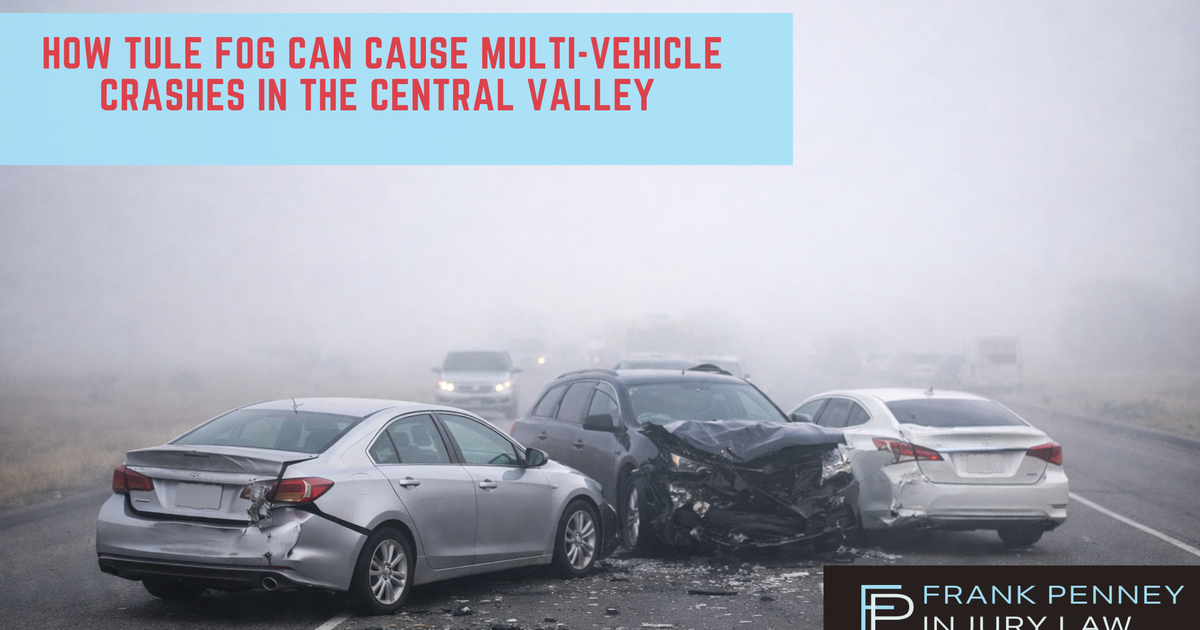
Every year, drivers across California’s Central Valley face one of the most dangerous weather conditions in the state: tule fog. While it may appear harmless at first glance, this dense, ground-level fog has been responsible for some of the most devastating multi-vehicle crashes in California history. Understanding how and why these crashes happen is critical because it can potentially protect your legal rights if you or a loved one is injured.
What Is Tule Fog?
Tule fog is a thick, low-lying radiation fog that forms in California’s Central Valley, typically between November and March after periods of rain. It typically develops when moist ground air cools rapidly overnight, the winds remain calm, and a temperature inversion traps cold air near the surface.
Because the Central Valley is surrounded by mountains, the fog becomes trapped and stagnant, sometimes lingering for days at a time. As a result, visibility in tule fog can drop dramatically from a few hundred feet to as little as 10 feet or less in seconds.
Why Tule Fog Is So Dangerous for Drivers
Sudden Loss of Visibility- Drivers may go from clear conditions to near-total blindness in just moments. This makes it nearly impossible to react in time to stopped vehicles, traffic signals, or road hazards.
Inconsistent Visibility Across Short Distances- Visibility can vary drastically within a few feet, meaning one driver may see clearly while another just ahead is completely obscured.
Extended Duration- Unlike coastal fog that burns off quickly, tule fog can last for hours or even days, especially during winter inversion patterns.
Additional Road Hazards- Tule fog is sometimes accompanied by moisture buildup, slick roads, and occasional freezing drizzle and black ice.
How Tule Fog Leads to Multi-Vehicle Crashes
Due to the lack of visibility, drivers are not able to see any vehicles nearby until it is probably too late. When that occurs, it can potentially cause a chain-reaction collision, which are some of the most catastrophic outcomes that can happen in areas with tule fog. Here’s how these crashes typically unfold:
Initial Slowdown or Collision- A driver reduces speed or stops due to low visibility.
Following Drivers Fail to React in Time- Because they cannot see far ahead, trailing drivers continue at unsafe speeds.
High-Speed Impact- Vehicles collide with little or no braking distance.
Cascade Effect- Additional vehicles pile into the crash scene, often involving dozens of cars and commercial trucks.
Why the Central Valley Is Especially High Risk
The Central Valley is particularly prone to fog-related crashes because it experiences frequent tule fog events during winter months. Which means, cities like Fresno, Bakersfield, Stockton, and Modesto are all likely to get tule fog and major highways like State Route 99 and Interstate 5 become very dangerous areas that require extra precaution. For those who are not familiar with tule fog or the Central Valley, they are at high risk of getting involved in car accidents.
How a California Personal Injury Lawyer Can Help
Tule fog is more than just a seasonal inconvenience, but it is one of the leading causes of weather-related accidents in California. For those who are unaware of such weather conditions will become susceptible to multi-car collisions and will likely suffer catastrophic injuries. As such, if you or a loved one has been injured in a fog-related accident, Frank Penney Injury Lawyers is here to help you understand your rights and get on the path of recovery.
Call us today at 888-888-0566 or by filling out our online contact form to schedule your free case consultation.