
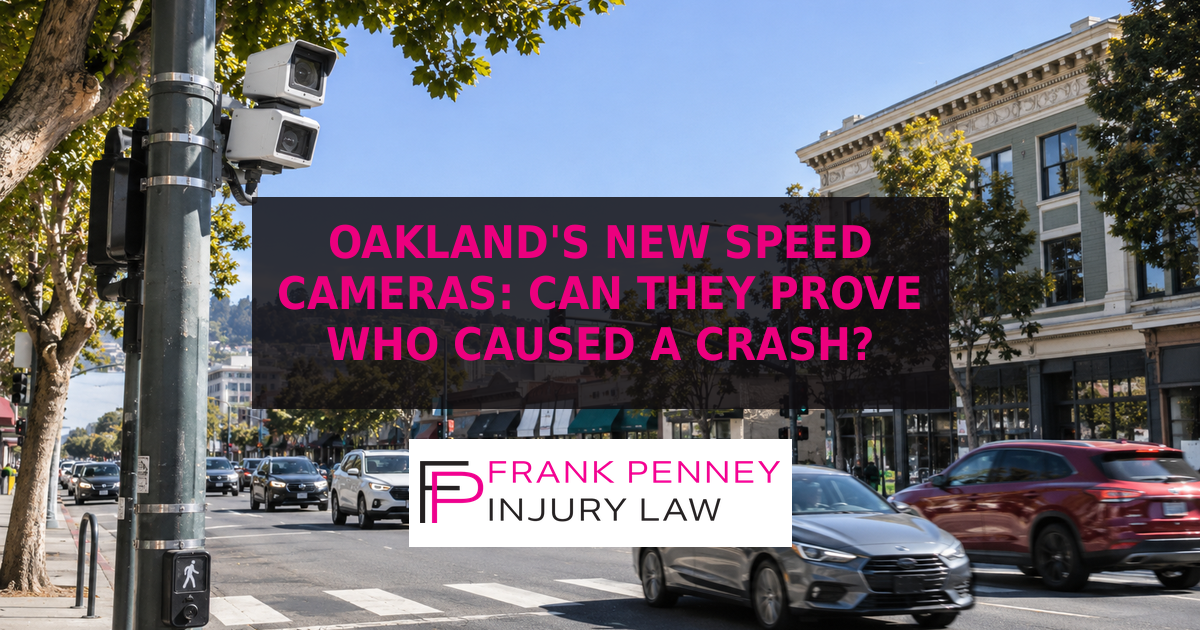
Speeding continues to be a major road safety concern throughout Oakland, particularly along busy corridors where motorists share the road with pedestrians, bicyclists, and public transportation. In an effort to reduce traffic-related injuries and fatalities, the City of Oakland introduced automated speed cameras in January 2026 to monitor vehicles traveling above posted speed limits.
Although the cameras are primarily intended to discourage dangerous driving, their introduction raises an important question for people injured in traffic accidents: Can Oakland's new speed cameras help prove who caused a collision? While these systems can document certain speeding violations, their usefulness in personal injury claims depends on what information was collected, whether it can be legally obtained, and how it relates to the circumstances of the accident.
What Is Oakland's New Speed Camera Program?
Oakland's Speed Safety Camera Pilot Program is an automated traffic enforcement initiative authorized under California Assembly Bill 645 (AB 645). The legislation allows participating cities to use radar- or laser-based camera systems to identify vehicles exceeding posted speed limits in designated areas.
Under California Vehicle Code § 22426, the cameras detect vehicles traveling at least 11 miles per hour above the posted speed limit. When a violation is identified, the system captures a photograph of the vehicle's rear license plate, along with information about the recorded speed, location, and time of the violation.
Unlike conventional traffic stops, these cameras do not require a police officer to be physically present and mails a notice to the vehicle's registered owner instead. Automated enforcement began with a warning period on January 14, 2026, followed by the issuance of speeding citations beginning March 15, 2026.
Where Are Oakland's New Speed Cameras Located?
Oakland's speed cameras are concentrated in areas that are identified as having elevated risks of serious traffic injuries and fatalities. Some of the monitored locations include:
International Boulevard: Between 40th and 41st Avenues, where the posted speed limit is 25 mph.
Broadway: Between 26th and 27th Streets, where the posted speed limit is 20 mph.
Hegenberger Road: Between Spencer and Hawley Streets, where the posted speed limit is 40 mph.
Fruitvale Avenue: Between Galindo and Logan Streets, where the posted speed limit is 25 mph.
West Grand Avenue: Between Chestnut and Linden Streets, where the posted speed limit is 30 mph.
73rd Avenue: Between Fresno and Krause Avenues, where the posted speed limit is 30 mph.
In its six-month program report published August 20, 2026, the Oakland Department of Transportation reported that the number of vehicles traveling at least 11 mph over the posted limit decreased by an average of 70% across the 18 monitored locations compared with 2024 baseline measurements. Although the findings suggest that the cameras have helped discourage speeding, lower vehicle speeds do not necessarily establish that every collision in these areas can be prevented or that camera records will be available to determine liability after an accident.
Can Oakland's Speed Cameras Prove Who Caused a Car Accident?
Oakland's speed cameras may provide information relevant to a car collision, but they cannot establish fault on their own because these systems are designed to detect speeding violations rather than continuously record traffic conditions or document accidents as they occur. Under California Vehicle Code § 22425, speed safety systems are restricted to photographing the rear of a vehicle and its license plate and are not permitted to record conventional video footage or capture the driver's face.
As a result, a camera record may establish that a particular vehicle was traveling above the posted speed limit at a specific location and time. However, it cannot independently determine who was operating the vehicle, what actions people took before the accident, and whether speeding contributed to the collision.
Can Speed Camera Evidence Be Used in a California Personal Injury Lawsuit?
Although California imposes substantial restrictions on accessing and disclosing records collected through automated speed enforcement programs (as per California Vehicle Code § 22425(l)), public agencies may access and use the records only for authorized purposes under the program or to evaluate its effects.
Consequently, a person pursuing an injury claim may be able to seek relevant records through an appropriate legal process. Whether those records are ultimately disclosed or admitted as evidence depends on the circumstances, applicable legal protections, and court rulings. Even if a photograph or recorded speed measurement becomes available, its reliability and relevance may need to be established.
How Long Does Oakland Keep Speed Camera Records?
Under California Vehicle Code § 22425(l), photographic evidence that does not result in a notice of violation must be destroyed within five business days after it is created. Records associated with issued violations may be retained for up to 60 days after the violation's final disposition, but it is subject to applicable retention policies and exceptions.
These limitations mean that relevant information may no longer exist by the time an injured person requests it. With that in mind, it is crucial that injury victims contact a personal injury lawyer as soon as possible, so they can evaluate whether they need to send a preservation request to obtain speed camera footage.
How Does California Law Determine Fault in a Speeding-Related Accident?
California typically determines traffic collision fault through negligence principles rather than relying exclusively on whether a driver received a speeding citation. Under California Civil Code § 1714, people have a duty to exercise reasonable care to avoid causing injuries to others and anyone who fails to exercise that, whether it means to maintain appropriate speeds or respond reasonably to road conditions, may be found negligent when their conduct causes an accident.
Furthermore, other state laws like California Vehicle Code § 22350 (basic speeding law) and California Evidence Code § 669 (rule of negligence) can become relevant in a car accident claim. While a speeding violation that occurred shortly before an accident may be relevant, it does not automatically establish that the speeding driver caused the crash.
What Happens If Both Drivers Share Responsibility?
California follows a pure comparative negligence system, meaning multiple parties may share responsibility in the event of a collision. For instance, one motorist may be speeding while another makes an unsafe left turn and if both actions contributed to the accident, each driver may be assigned a percentage of fault.
Under the state’s comparative fault rules, an injured person's compensation may be reduced according to their percentage of responsibility. If an injured motorist sustains $100,000 in legally recoverable damages and is determined to be 20% responsible for the collision, their recovery would generally be reduced to $80,000. Therefore, even when speeding can be established, an investigation must consider the actions of everyone involved.
Injured in an Oakland Car Accident? Contact Frank Penney Injury Law
Oakland's new speed camera program may help discourage dangerous driving, but determining responsibility after a serious accident often requires more than evidence of a speeding violation. When liability is disputed, a thorough investigation may be necessary to identify the responsible parties and establish how their actions contributed to the injuries.
At Frank Penney Injury Lawyers, our team of car accident lawyers understand how impactful sudden crashes can have on a person’s life and are committed to delivering the legal representation they need to move forward from. With decades of experience fighting for people’s rights, injury victims can rest easy knowing their case is being handled with the utmost care and respect.
Contact our firm at 888-888-0566 or by filling out our online contact form today for a free consultation.