

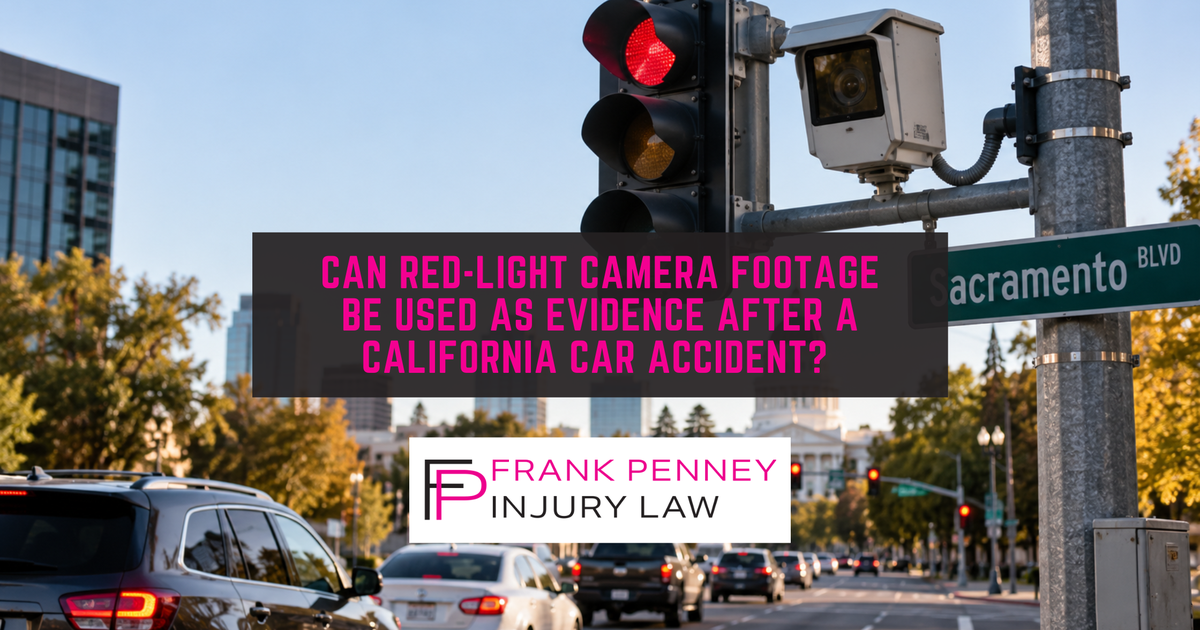
When a car accident happens at an intersection, determining which driver had the right of way can quickly become one of the most disputed parts of an insurance claim. One driver may insist the light was green while the other claims the opposite. Without an independent witness, proving what actually happened may be difficult.
However, red-light camera footage can potentially provide valuable evidence in these situations. For someone injured in an intersection accident in Northern California, identifying and preserving available video evidence as soon as possible can therefore be an important part of investigating the crash.
What Are Red-Light Cameras?
The term "red-light camera" is commonly used to describe cameras installed at intersections to detect vehicles that enter after a traffic signal turns red. California law refers to these systems as automated traffic enforcement systems (ATES) and these systems should not be confused with every camera visible at an intersection. Depending on the location, a camera may be used for automated traffic enforcement, traffic monitoring, or other municipal purposes.
Can Red-Light Camera Footage Be Used as Evidence in a California Car Accident Claim?
California courts permit photographs and video recordings to be introduced as evidence in a car accident claim when they satisfy applicable evidentiary requirements. For instance, in People v. Goldsmith (2014), the California Supreme Court concluded that photographs, a 12-second video, and computer-generated information from an automated traffic enforcement system was sufficient enough evidence that was relevant to the case.
Although Goldsmith involved a traffic violation rather than a personal injury lawsuit, its discussion of authentication and machine-generated photographic evidence was important when evaluating similar evidence in civil litigation. However, a party seeking to rely on camera footage may need to establish that the recording is actually what that party claims it is.
What Can Red-Light Camera Evidence Show?
The usefulness of red-light camera evidence will depend on the type of system involved and what information it captures. Potentially useful evidence could include:
The position of the vehicles- Images may establish where one or more vehicles were immediately before or during a collision.
Whether a vehicle entered the intersection- Footage may help establish when a vehicle crossed the limit line or entered the intersection.
The traffic signal phase- Certain systems may provide visual or electronically generated information concerning whether a signal was green, yellow, or red.
The timing of events- Time stamps can help investigators establish a sequence leading up to a collision.
Vehicle identification- Images may show vehicle characteristics or license plates that can help identify a vehicle involved in a crash.
Direction of travel- Video can help establish which direction the vehicles were traveling and how they approached the intersection.
However, it is important to note that some automated systems can provide substantially more information than a traditional photograph.
How Is Red-Light Camera Footage Authenticated in California?
Obtaining red-light footage does not automatically mean that it will be admissible at trial. Under California Evidence Code § 1401, authentication is generally required before something can be admitted into evidence and in order to authenticate potential evidence, it essentially requires sufficient relevance and validity to support a finding.
For example, the California Supreme Court explained in People v. Goldsmith that the foundation necessary to authenticate a photograph or video depends partly on what the evidence is being offered to prove. This can be particularly important for automated cameras because there may not be a person physically operating the camera when the accident occurs.
Is Red-Light Camera Footage Hearsay?
Machine-generated red-light camera evidence generally presents a different hearsay issue than statements made by a person. The distinction is important because hearsay generally involves an out-of-court statement offered to prove the truth of what the statement asserts.
However, a camera recording what happens at an intersection does not necessarily make a human statement about what happened. Instead, the system may automatically capture the event, but this does not mean that every piece of camera evidence will automatically be admissible. Other evidentiary objections may still apply, including questions involving:
Authentication
Accuracy
Reliability
Relevance
Alteration or editing
The completeness of the recording
Whether another evidentiary rule requires exclusion
What if the Other Driver Claims the Video Was Altered?
A very common complaint about red-light footage is that the video was altered or edited in a way that disproves one side’s story. Digital evidence can potentially be challenged on the basis that it was edited, manipulated, corrupted, or otherwise unreliable. However, the fact that digital images can theoretically be altered does not automatically make them inadmissible.
If there is actual evidence that footage has been altered, then it could impact the outcome of a claim, however, the dispute could affect its admissibility or the weight a judge or jury gives it. Maintaining the original file, associated metadata, records concerning where it came from, and documentation showing how the evidence was obtained can therefore become important when preserving digital evidence for litigation.
How Do You Get Red-Light Camera Footage After an Accident?
There is no single statewide database where California accident victims can simply download footage from every intersection. Instead, accident victims will need to contact the department that owns/control that particular camera. For example, some potential departments may include any of the following:
A city transportation department
Local police or sheriff's department
A municipal traffic-management agency
Caltrans
Other governmental agencies
Due to the nature of red-light cameras, an attorney investigating the crash may first identify cameras around the intersection and determine which agencies or private entities control them. From there, obtaining evidence may involve a public records request, preservation request, subpoena, discovery demand, or another legal process depending on who possesses the recording and the stage of the case.
How Long Is Traffic Camera Footage Kept in California?
There is no universal retention period that applies to every traffic camera in California. Retention policies can vary significantly depending on the agency, city, camera system, and purpose of the recording.
Some systems may overwrite recordings after a relatively short period, others may retain footage connected with a traffic citation or law enforcement investigation for longer periods, and some cameras do not save footage at all.
For example, Caltrans states that its freeway CCTV cameras are used for traffic-management purposes and that the video is not recorded or saved. This is why accident victims should not assume footage will still be available months after a collision.
What if There Is No Camera Footage?
The absence of red-light footage does not prevent an injured person from pursuing a California car accident claim. It is important to remember that red-light footage is one of many types of evidence that can be submitted to prove a claim and there are many other pieces of information out there that can be used as evidence. Depending on the circumstances, evidence may include:
Police collision reports
Eyewitness statements
Photographs of the accident scene
Vehicle damage
Skid marks and debris patterns
Cellphone records
Vehicle telematics
Traffic signal timing records
Accident reconstruction analysis
Admissions made by the drivers
Sometimes several seemingly minor pieces of evidence become significant when considered together, so it is important to take a look at everything and if you need help, a car accident lawyer can analyze the evidence and determine whether it is useful or not.
Contact Frank Penney Injury Lawyers Today
Red-light camera footage can potentially provide powerful evidence after a California intersection accident. However, the existence of a camera does not guarantee that footage exists. If you or a loved one was injured in a car accident in California, a car accident lawyer from Frank Penney Injury Lawyers can analyze the case and give you the legal guidance you need.
Contact our firm at 888-888-0566 or by filling out our online contact form today for a free consultation.