

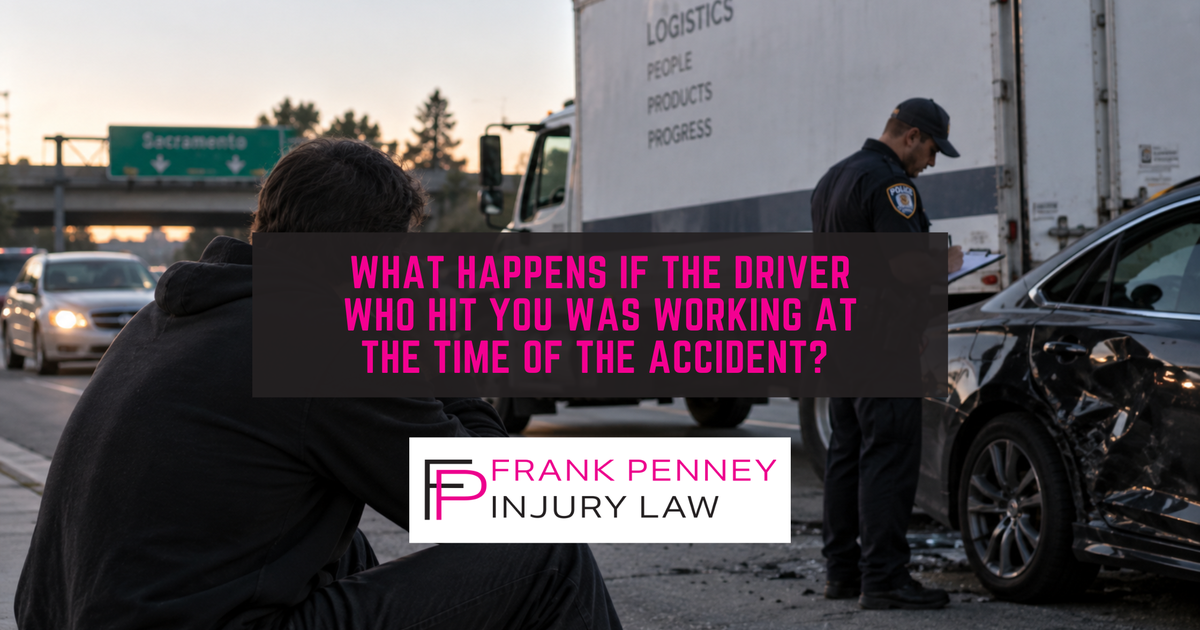
A car accident claim may become more complicated when the person who caused the crash was working at the time. Instead of pursuing compensation solely from the individual driver and their auto insurance carrier, California recognizes the doctrine of respondeat superior, if you were injured in a car accident from someone who was working, you may be eligible to recover compensation from the driver’s employer.
What Is Respondeat Superior?
Respondeat superior is a legal doctrine that allows an employer to be held vicariously liable for certain wrongful acts committed by an employee within the scope of employment. California Civil Code § 2338 outlines how an employer is responsible for their employee’s action during a “transaction of the business of the agency”.
For example, imagine a delivery company sends an employee across Sacramento to deliver an order and the employee negligently runs a red light and crashes into another vehicle. Although the employee was physically driving the vehicle, the injured motorist may potentially pursue a claim involving both the driver and the employer because the employee was performing work for the business when the collision occurred.
Can an Employer Be Liable for an Accident Caused by an Employee?
The fact that someone was employed at the time of an accident does not automatically make their employer responsible, because the key issue is whether the employee was acting within the course and scope of employment when the collision occurred.
Whether someone was acting within the scope of employment is often a factual question that depends on the circumstances surrounding the accident. For example, an employer could potentially face liability when an employee causes an accident while:
Making deliveries for the employer
Driving between job sites
Visiting a customer or client
Picking up equipment or supplies
Running a work-related errand
Transporting coworkers, customers, or company property
Traveling to a meeting or other work assignment
Performing another task requested or reasonably connected to the employee's job
How Do You Determine Whether the Driver Was "Within the Scope of Employment?"
There is no single fact that determines whether an employer is responsible for an employee's accident. An investigation may need to consider what the employee was doing immediately before the collision and why they were driving.
Important questions can include:
Where was the driver going? Traveling to a customer, worksite, meeting, warehouse, or delivery destination may support a connection to employment.
Why was the trip being made? A trip requested by a supervisor may be different from a purely personal trip.
Who benefited from the trip? Travel that furthered the employer's business may weigh in favor of employer liability.
Was the employee being paid? Being on the clock may be relevant, although it is not necessarily conclusive.
Who owned the vehicle? A company-owned vehicle may provide important evidence, but employees can also perform work in personal vehicles.
Did the employer require the employee to drive? Some employees are expected to maintain access to a vehicle as part of their jobs.
Was the employee carrying company property? Tools, packages, equipment, documents, or other business materials can help establish the purpose of a trip.
Did a supervisor instruct the employee to make the trip? Emails, text messages, dispatch records, schedules, and other communications may help establish what the driver was doing.
Because these cases can depend heavily on evidence, identifying the driver's employer and preserving employment-related records can become an important part of a personal injury investigation.
What If the Employee Was Driving Their Own Car?
A common misconception is that an employer cannot be held liable unless the employee was driving a company vehicle. However, that is not necessarily true, because an employee may use a personal vehicle while performing duties for an employer.
Furthermore, California courts have recognized circumstances in which an employer can face liability related to an employee's use of a personal vehicle when that use was required by or provided a benefit to the employer. For example, an employee may regularly use their own vehicle to meet clients, make deliveries, or perform fieldwork.
In fact, the California Court of Appeal addressed this issue in Newland v. County of Los Angeles (2018), where an employer can be held liable for an employee driving a personal vehicle to or from work if, at the time of the accident, the employee's use of the vehicle was required by the employer or otherwise provided a benefit to the employer. However, simply owning a vehicle that is occasionally used for work does not automatically make every trip work-related.
Does an Employer Have to Pay If an Employee Causes an Accident During Their Commute?
Usually, an ordinary commute presents a different situation. Under California's "going and coming" rule, employees traveling to or from their regular workplace are generally considered outside the scope of employment. As a result, an employer ordinarily is not vicariously liable simply because an employee caused an accident while commuting home after a normal workday.
However, exceptions may arise when the employee is completing a special errand for the employer, transporting work equipment, or is traveling for business purposes. For this reason, an insurer's statement that the employee was merely "driving home" does not necessarily resolve the issue.
What If the Employee Was On Call?
Being on call can create additional questions about whether a driver was acting within the scope of employment. In Moreno v. Visser Ranch, Inc. (2018), a California appellate court found factual issues that could determine when an on-call employee is acting within the scope of employment when the accident occurred and determined that the employee must be working within the scope of employment.
Can the Company That Owns the Vehicle Also Be Liable?
California Vehicle Code § 17150 outlines how a vehicle owner can be responsible for injuries or property damage resulting from negligent or wrongful operation of the vehicle by someone using it with the owner's express or implied permission. This theory is distinct from respondeat superior, because this law focuses on vehicle ownership and permissive use and that distinction can matter when a company owns the vehicle involved in the accident.
Depending on the circumstances, additional claims such as negligent hiring, negligent supervision, negligent retention, negligent training, or negligent entrustment may also require investigation. These are fact-dependent theories and should not be assumed merely because an employee caused a collision.
Frank Penney Injury Lawyers Can Investigate Whether an Employer Is Liable
When someone causes a collision while performing their job, the resulting personal injury claim may involve substantially more than the driver's personal auto insurance policy. Depending on the nature of the car accident, the employer, vehicle owner, commercial insurer, or another business may potentially have legal or financial responsibility.
At Frank Penney Injury Lawyers, our team of accident attorneys can investigate the driver's employment status and determine whether the driver was acting within the scope of employment. By hiring our team for your case, you can rest easy knowing that your case is in the right hands.
Contact our firm at 888-888-0566 or by filling out our online contact form today for a free consultation.