
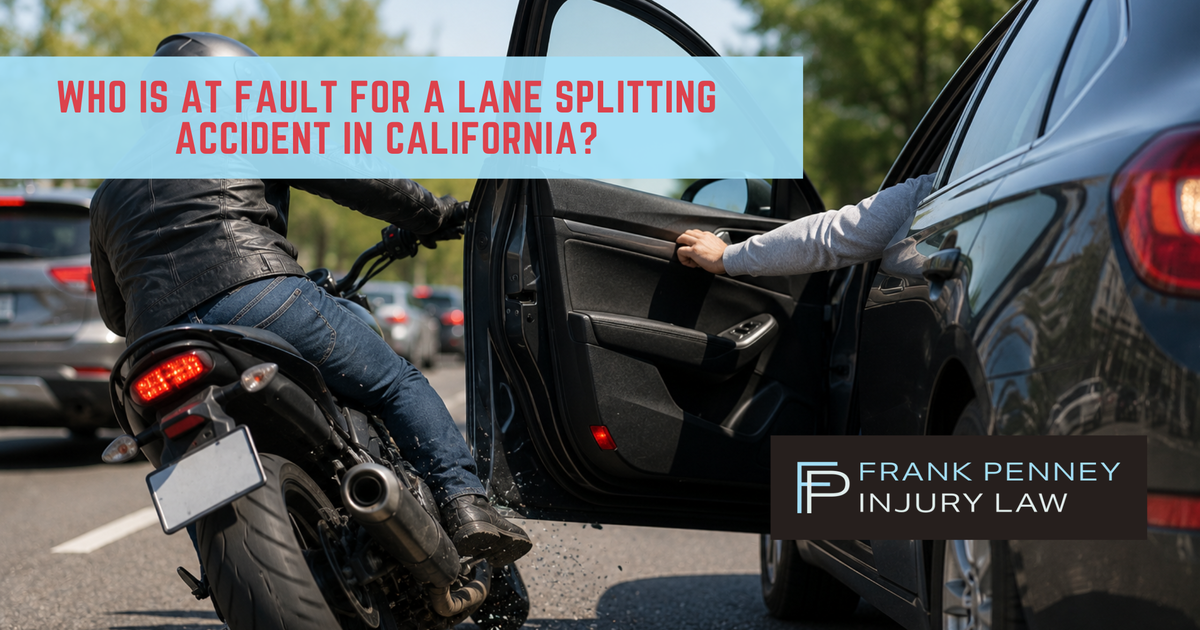
Lane splitting is when a motorcyclist rides between lanes of slow-moving or stopped traffic and to many people’s surprise, this act often raises serious questions after an accident. If a crash occurs while a motorcyclist is lane splitting, determining fault is not always straightforward, because liability depends on the specific actions of both the motorcyclist and surrounding drivers, as well as how those actions align with California law.
Is Lane Splitting Legal in California?
California is the only state where lane splitting is explicitly legal as it is outlined in California Vehicle Code § 21658.1. However, legality does not mean motorcyclists can lane split without restriction. The law requires that lane splitting must be done in a safe and prudent manner, meaning liability often comes down to whether the rider acted reasonably under the circumstances.
Why Lane Splitting Cases Are More Complex
Lane splitting accidents tend to be more complicated than standard car crashes because there is often bias against motorcyclists where most insurance companies may argue the rider was reckless. Additionally, due to the state’s definition of lane splitting, there may be conflicting interpretations of what is considered to be “safe and prudent” behavior. Because of this, these cases often require strong legal advocacy and detailed evidence to establish fault accurately.
How Fault Is Determined in Lane Splitting Accidents
California follows a comparative negligence system, which means fault can be shared between multiple parties in the event where liability and fault is not clear or is heavily disputed. In such scenarios, liability would be split by their percentage of fault and each party becomes responsible for their portion of the damages.
For example, if you are 30% at fault and your damages total $100,000, you can still recover $70,000 after your degree of fault is taken into account. In a lane splitting accident, investigators, insurance companies, and attorneys will examine evidence such as the following is precisely calculate each party’s degree of fault:
Speed of the motorcyclist and surrounding vehicles
Traffic conditions (stop-and-go vs. free-flowing)
Whether the motorcyclist was weaving aggressively
Whether a driver made an unsafe lane change
Visibility and road conditions
Compliance with traffic laws
Common Scenarios and Who May Be at Fault
1. Driver Changes Lanes Without Checking Blind Spots
If a driver suddenly switches lanes without signaling or checking for motorcycles, they may be primarily at fault. While motorcycles are smaller and harder to see, drivers still have a duty to check mirrors and blind spots, use turn signals, and ensure it is safe before merging. Any failure to do so can make the driver liable for the crash.
2. Motorcyclist Is Speeding While Lane Splitting
If a motorcyclist is traveling significantly faster than surrounding traffic, they may be found partially or fully at fault. The California Highway Patrol (CHP) guidelines suggest that lane splitting should occur at safe speeds and ideally no more than 10 mph faster than traffic flow. Any excessive speed beyond those suggestions significantly reduces reaction time and increases liability in the event of an accident.
3. Driver Intentionally Blocks or Harasses a Motorcyclist
Some drivers react negatively to lane splitting and may drift into the motorcyclist’s path, open car doors, and even attempt to block passage. All of these actions are not only illegal, but very dangerous to the motorcyclist and everyone nearby. In these cases, the driver is likely to bear significant fault and would be responsible for all accrued damages.
4. Motorcyclist Weaving Aggressively Between Lanes
If a rider is rapidly switching between lanes in high-speed traffic or is riding unpredictably, they may be considered negligent due to their driving behavior. Even though lane splitting is legal, unsafe execution can shift liability onto the rider, because even motorcyclists have to exercise a standard duty of care to prevent any foreseeable accidents from occurring.
5. Rear-End Collisions During Lane Splitting
If a motorcyclist rear-ends a vehicle while lane splitting, they may be at fault especially if they were following too closely or traveling too fast for conditions. However, if the driver stopped suddenly or unpredictably, fault could still be shared between parties, but additionally evidence would be required to determine this.
Can You Still File a Claim After a Lane Splitting Accident?
Being involved in lane splitting does not automatically disqualify you from filing a personal injury claim. In fact, you may be entitled to compensation for any out-of-pocket costs:
Medical expenses
Lost wages
Property damage
Physical therapy
Quality of life adjustments
The key to recover these damages is proving that the other party acted negligently and contributed to the accident.
Contact Frank Penney Injury Lawyers Today
While lane splitting is legal in California, both motorcyclists and drivers must exercise caution and follow traffic laws. However, if you’ve been injured in a lane splitting accident, understanding your rights and how fault is determined can make a major difference in your ability to recover compensation.
At Frank Penney Injury Lawyers, our firm has been fighting for people’s rights for over three decades and our team of attorneys are committed to deliver top-tier legal representation and ensure you get the compensation you deserve.
Call usat 888-888-0566 or by filling out our online contact form today to schedule your free case consultation.