

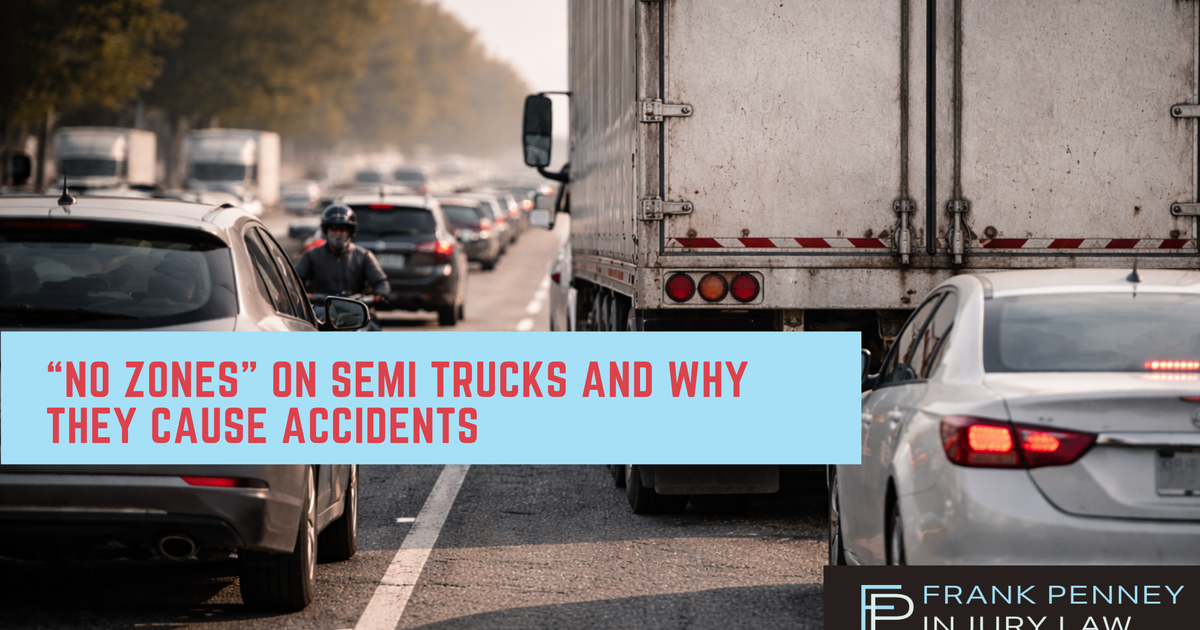
From the I-5 freight corridor to the busy 405, 101, and 99, sharing the road with massive commercial trucks is a daily reality on California’s highways reminding everyone how troublesome they can be especially if you are in a hurry. While semi trucks are essential to transporting goods across the state, they also create serious roadway hazards, especially when drivers fail to understand or respect “No-Zones.”
What Are No-Zones?
No-zones are large blind-spot areas around semi trucks where the truck driver has limited or no visibility. These blind spots are significantly larger than those of a regular car, and when passenger vehicles linger in these areas, the risk of a catastrophic collision increases dramatically. For California drivers, understanding where no-zones are and how they contribute to accidents is crucial for staying safe and knowing your rights after a crash.
What Are the Four Main No-Zone Areas?
The Right-Side No-Zone- The largest blind spot on a semi truck, because truck drivers cannot see vehicles extending across multiple lanes on the right side. As trucks often have to make wide right turns, they may drift when changing lanes and this is one of the most dangerous areas for passenger vehicles.
The Left-Side No-Zone- Although smaller than the right-side blind spot, the left side still has a large area where passenger vehicles disappear from the truck driver’s view, particularly near the truck’s trailer. While the truck driver will have better visibility, this area can still be just as dangerous as any other.
The Rear No-Zone- Drivers should never follow a semi truck too closely from behind.As truck mirrors do not give drivers visibility of vehicles directly behind them for a substantial distance, tailgating not only hides your car from the truck driver but prevents you from seeing road hazards ahead.
The Front No-Zone- Because trucks sit much higher off the ground, they have a significant blind spot directly in front of the cab. If a vehicle cuts too closely in front of a truck, the truck driver will not be able to see it and the truck will not be able to stop quickly enough to avoid a rear-end collision.
Why Do No-Zones Cause So Many Accidents?
Semi trucks can weigh up to 80,000 pounds, making visibility, reaction time, and stopping distance critical safety factors. The Federal Motor Carrier Safety Administration (FMCSA) reports that blind-spot crashes account for thousands of commercial-vehicle collisions each year, particularly on the right side or directly behind the trailer.
These dangers are compounded by the fact that fully loaded semi trucks require 20% to 40% more stopping distance than passenger cars, meaning a sudden merge into the front no-zone can leave a truck driver unable to brake in time. In addition, when distraction, fatigue, delivery pressure, or impairment are added, the likelihood that a truck driver will miss a vehicle in a no-zone increases significantly.
Who May Be Liable for a No-Zone Accident in California?
Liability in a truck accident depends on the circumstances, but potentially responsible parties include:
The truck driver- For improper lane changes, failing to check mirrors, fatigue, or distraction.
The trucking company- For negligent hiring, poor training, or unrealistic delivery schedules.
Maintenance companies- If faulty mirrors or safety equipment contributed.
Cargo loaders- If shifting cargo caused instability.
Other drivers- If they cut off the truck or stayed in the blind spot too long.
However, if multiple parties were responsible for causing the truck accident, California uses a comparative negligence system (as per CA Civil Code 1714), meaning you may still recover compensation even if you were partially responsible.
How to Avoid No-Zone Crashes in California
Drivers can reduce their risk of a collision by following safety tips:
Avoid lingering in blind spots, pass quickly but safely.
If you can’t see the truck driver’s mirrors, assume the driver can’t see you.
Don’t cut in front of trucks, especially in fast-moving traffic.
Give commercial trucks extra space during lane changes and wide turns.
Maintain a safe following distance of at least four seconds.
Use signals clearly and early to avoid surprising truck drivers.
Injured in a No-Zone Truck Accident? Frank Penney Injury Lawyers Can Help
If you or a loved one were injured in a crash involving a semi truck’s no-zone, you may be entitled to compensation for damages. At Frank Penney Injury Lawyers, our firm understands how devastating semi-truck accidents can be and are confident that they can give you the legal guidance you need during this stressful time.
Call us today at 888-888-0566 or by filling out our online contact form for a free case consultation.