
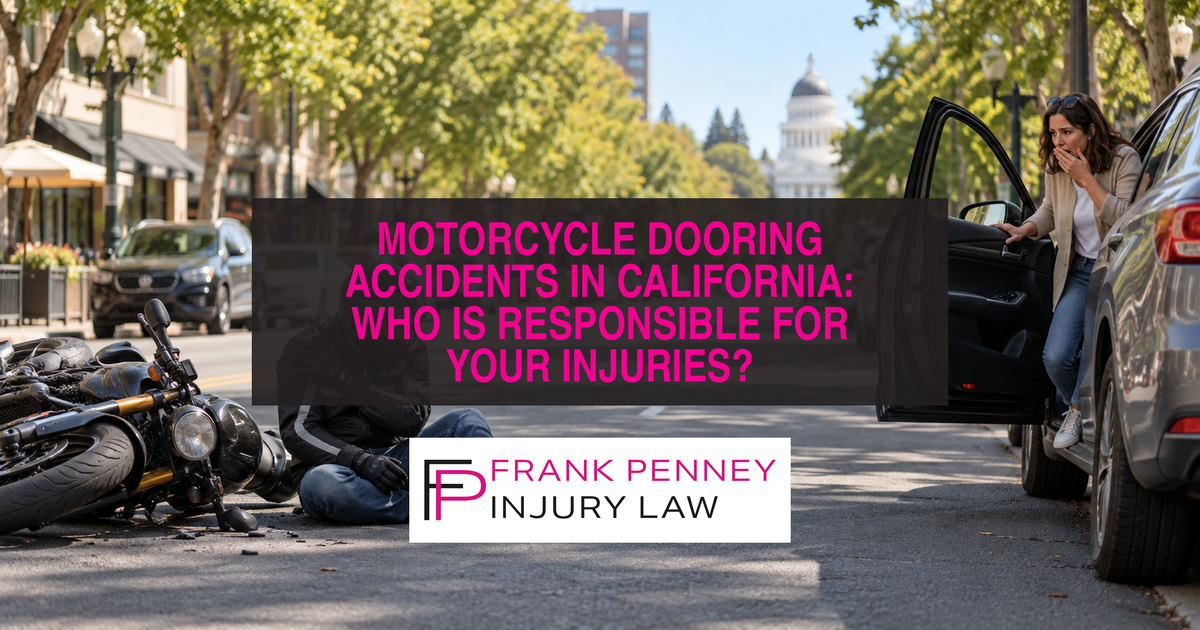
Short answer: In California, the person who opens a car door into traffic is usually responsible for a motorcycle dooring crash. Vehicle Code § 22517 requires drivers and passengers to make sure it's safe before opening a door, and a violation can create a presumption of negligence.
A car door opening into your path gives you less than a second to react. On a motorcycle, that's often not enough. You hit the door, or you swerve and go down, and either way you're the one who absorbs the impact.
California law is clear about who has to look before opening a door: the person opening it. If you were hurt in a dooring crash, that rule is the starting point for your claim. Below, we explain who can be held responsible, how insurers try to shift blame onto riders, and what to do in the days after a crash.
What Is Dooring?
A dooring accident happens when a driver or passenger opens a vehicle door into the path of an oncoming rider. It covers more than a direct hit. If you braked hard, swerved into another lane, or laid the bike down to avoid the door, that is still a dooring crash, and the person who opened the door can still be responsible.
The danger zone is the strip of road about three to four feet from parked cars, often called the "door zone." Riders end up there constantly: next to curbside parking, alongside stopped traffic, and while splitting lanes.
The situations we see most often:
Parallel parking. A driver parks and swings the door open without checking the mirror.
Passenger drop-offs and rideshare stops. A passenger exits on the traffic side, often in a hurry, while the car is double-parked or stopped in a travel lane.
Stopped traffic. Someone opens a door while their car is stuck in a backup, right as a rider filters past.
Loading and unloading. A door is left open into the lane while someone handles groceries, kids, or cargo.
These crashes cluster where curbside parking meets steady traffic: Midtown Sacramento's grid of one-way streets, downtown Oakland, Stockton's Miracle Mile, and the commercial strips of Roseville and Modesto.
The numbers back that up. In 2023, 154 people were killed or injured in motorcycle crashes in the City of Sacramento, ranking it 5th of 15 similar-size California cities, according to the California Office of Traffic Safety.
The Law: California Vehicle Code § 22517
California Vehicle Code § 22517 says no one may open a door on the traffic side of a vehicle unless it is reasonably safe and won't interfere with moving traffic. It also bars leaving a door open on that side longer than needed to load or unload passengers.
Two details in that law matter for riders:
It applies to "any person." Passengers are covered just like drivers. The person whose hand was on the handle is responsible for checking.
It protects moving traffic, and a motorcycle is moving traffic. That includes a rider filtering past stopped cars.
Why a Violation Is So Important: Negligence Per Se
In a personal injury case, you normally have to prove the other person was careless. When someone breaks a safety law like § 22517, California Evidence Code § 669 can shift that burden. If the violation caused your injuries, and the law exists to prevent exactly this kind of crash to exactly this kind of person, the court presumes the person was negligent.
That presumption can be challenged. The defense can argue the person acted as a reasonably careful person would have. But it means the case starts with the other side explaining why opening a door into your path was reasonable, not with you proving it wasn't.
Who Can Be Held Responsible
The person who opened the door. In most dooring cases, this is the main defendant. Their auto insurance, or the car owner's policy, is usually the first source of compensation.
The driver, when a passenger opened the door. A driver isn't automatically liable for a passenger's mistake. But a driver who stopped in a travel lane, double-parked, or told a passenger to hop out into traffic may share fault.
Rideshare and delivery drivers. Uber, Lyft, and delivery drivers stop in awkward spots all day. If a rideshare trip was underway, the company's insurance may come into play, and which policy pays depends on whether the driver had the app on, had accepted a ride, or had a passenger in the car. That's one reason Uber and Lyft accident claims get complicated. Delivery vans raise similar questions about who is liable when a delivery driver causes an accident. Save any trip details you can get, such as the car's markings or a screenshot from a witness.
Businesses and other drivers. A commercial driver unloading in a traffic lane, or another motorist who forced you toward an open door, can share responsibility too.
Insurers often start by asking how close the rider was to the parked cars and how fast they were going. The person who opened the door rarely says they checked their mirror and saw nothing. Usually they say they never looked.
When the Insurance Company Blames the Rider
Expect the other side's insurer to look for ways you contributed to the crash. The usual arguments: you were going too fast, riding too close to parked cars, or splitting lanes.
California uses pure comparative fault, a rule set by the California Supreme Court in Li v. Yellow Cab Co. (1975). You can recover damages even if you were partly at fault; your award is reduced by your share. Say a jury finds you 10% at fault for riding a little fast through a busy block. You still recover 90% of your damages. Insurers know this, which is why they push hard to inflate the rider's percentage. Here's more on what happens if the insurance company says you were partly at fault.
Lane splitting is legal. California Vehicle Code § 21658.1 defines lane splitting, and the CHP publishes guidance on doing it safely. Splitting lanes doesn't make you responsible when someone opens a door into you. The questions are whether your speed and spacing were reasonable for the conditions, and whether you had any realistic chance to avoid the door. We cover this in more depth in who is at fault for a lane splitting accident in California.
Not wearing a helmet doesn't cancel your claim. California's motorcycle helmet law (Vehicle Code § 27803) requires riders to wear one. If you weren't, the defense may argue it made a head injury worse. That can reduce compensation for that specific injury. It doesn't excuse the person who opened the door, and it doesn't affect claims for your broken leg or road rash.
If your motorcycle wasn't insured, know this rule. Under Civil Code § 3333.4, passed by voters as Proposition 213, an uninsured vehicle owner or driver generally can't recover noneconomic damages, such as pain and suffering, after a crash. You can still recover economic losses like medical bills and lost wages. There's an exception when the at-fault driver was convicted of DUI. This rule catches many riders who let coverage lapse on a bike they ride only part of the year.
Common Injuries in Dooring Crashes
A car door sits right at the height of a rider's knee and hip, so the first impact usually lands there. Then comes the second impact, with the pavement or another vehicle. The injuries we see most:
Broken legs, shattered kneecaps, and torn knee ligaments from the door itself
Broken wrists, collarbones, and dislocated shoulders from bracing for the fall
Concussions and traumatic brain injuries, even with a helmet
Back and neck injuries, including herniated discs and fractured vertebrae
Road rash injuries that require skin grafts or leave permanent scars
How badly you're hurt often depends on your speed, the angle of the hit, your gear, and whether you struck something else after the door. Some injuries, like knee damage and brain injuries, keep causing problems for months or years.
What to Do After a Dooring Crash
Get medical care. Call 911 if anyone is badly hurt. Get checked even if you feel fine; adrenaline masks pain, and some injuries don't appear until days after an accident.
Photograph the door before it moves. How far the door stood open into the lane is often the most important fact in the case. Get the car's position, the door, the hinge area, your bike, the road, and any skid marks.
Identify who opened the door. Get names and contact details for the driver, the passenger who opened the door, and witnesses. If it was a rideshare car, note the company and get the driver's name.
Ask about cameras quickly. Nearby shops, buses, and doorbell cameras often overwrite footage within days or weeks. A helmet cam or dashcam footage used as evidence can settle the case.
Report the crash. Call the police so there's an official report, and give a factual account without guessing about speed.
Keep your damaged gear. Your helmet, jacket, and boots are evidence of how the impact happened. Don't throw them out or repair the bike before it's documented.
Don't give a recorded statement to the other driver's insurance adjuster until you've talked to a lawyer, and don't accept an early settlement before you know the full extent of your injuries.
Not sure where you stand after a crash? Ask us for a free case review. There's no cost and no obligation.
What Compensation You Can Recover
A dooring claim can include economic damages: medical bills (now and future), lost wages, reduced earning capacity, motorcycle repair or replacement, and damaged riding gear. It can also include noneconomic damages: pain and suffering, emotional distress, and loss of enjoyment of life, subject to the Prop 213 rule above if you were uninsured.
The value depends on how badly you were hurt, the evidence of fault, how fault is split, and how much insurance is available. Anyone who quotes a number before seeing your medical records is guessing. Here's how we estimate what a personal injury case is worth.
Deadlines to File
You generally have two years from the crash to file a personal injury lawsuit in California (Code of Civil Procedure § 335.1).
If a government vehicle or employee was involved, such as a city truck or a transit bus, the deadline is much shorter: a claim with the agency within six months (Government Code § 911.2). Other rules can change the timeline, so don't wait to find out which applies.
Hurt in a Dooring Crash? Talk to Frank Penney Injury Law
If a car door put you on the pavement, you shouldn't be the one paying for it. Our motorcycle accident lawyers represent injured riders across Northern California, including Sacramento, Roseville, Stockton, Modesto, Oakland, and Redding. We investigate how the crash happened, track down the evidence before it disappears, and deal with the insurance companies so you can focus on recovering.
Call (888) 393-9971 or fill out our contact form for a free consultation. We work on contingency, so there are no upfront attorney fees, and you pay attorney fees only if we recover compensation for you.
Frequently Asked Questions
Can I sue someone for opening their car door into my motorcycle?
Yes. Opening a door into traffic when it isn't safe violates Vehicle Code § 22517, and that violation can create a presumption of negligence. You'll still need to show the door caused your injuries.
What if I crashed avoiding the door and never hit it?
You can still have a claim. If the door forced you to brake, swerve, or lay the bike down, the person who opened it can be responsible. Witnesses and video matter more in these cases, because there's no contact damage on the door.
Is the driver responsible if a passenger opened the door?
Not automatically. The person who opens the door has their own duty to check. The driver can share fault if they stopped somewhere unsafe or told the passenger to get out into traffic.
Does my own motorcycle insurance help?
It can. If the at-fault driver doesn't have enough insurance to cover your injuries, your uninsured/underinsured motorist coverage may pay. Medical payments coverage on your policy can help with early bills regardless of fault. Check your declarations page or have an attorney review it.
Can I recover if I wasn't wearing a helmet?
Yes, though it may reduce compensation for a head injury if the defense proves a helmet would have prevented or lessened it. It doesn't reduce compensation for unrelated injuries.
How long does a dooring claim take?
It depends on your injuries and whether fault is disputed. Most claims don't settle until your doctors can say what your long-term recovery looks like, because settling earlier risks leaving future medical costs uncovered.